Kolbe-Schmitt Process
Salicylic Acid Production Plant
Material Efficiency
99.5% conversion in CSTR
Energy Optimized
Total duty: 189 MW
Economically Viable
Production cost: $0.98/kg
Safety First
Comprehensive HAZOP analysis
Project Overview
Project Details
| University | Jazan University |
| Department | Chemical Engineering |
| Project Type | Senior Design Project 2025 |
| Students | Mohammed Ahmed Dighriri Marzoug Mohammed Musa Hazzazi |
| Supervisor | Dr. Saleh Matar |
Salicylic Acid Applications
Process Description
The industrial synthesis of salicylic acid primarily follows the Kolbe-Schmitt reaction, which carboxylates sodium phenoxide to produce the final product. The process begins with sodium phenoxide preparation in a CSTR reactor, followed by flash separation, carboxylation in an autoclave reactor, dilution, acidification, and purification steps including centrifugation and drying.
Key Reactions
Reaction 1: Sodium Phenoxide Formation (CSTR)
Conditions: 100°C, Atmospheric Pressure
Conversion: 99.5%
Reaction 2: Carboxylation (Autoclave)
Conditions: 125°C, 4.9 bar
Conversion: 70%
Reaction 3: Acidification
Conditions: 70°C to 20°C
Conversion: 99%
Interactive Process Flow Diagram
Legend
Equipment Design Specifications
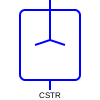
CSTR (R-101)
Volume: 1.267 m³
Dimensions: Ø1.024 × 1.536 m
Material: Carbon Steel 310
Agitator: Turbine, 196 RPM
Power: 0.362 hp
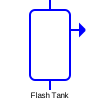
Flash Tank (FT-101)
Diameter: 0.819 m
Length: 2.457 m
Material: Stainless Steel 316
Thickness: 5 mm
Pressure: 101.3 kPa
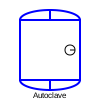
Autoclave (R-102)
Volume: 25 m³ (est.)
Pressure: 4.9 bar
Temperature: 125°C
Material: Stainless Steel 316L
Design: High Pressure
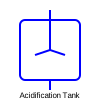
Acidification Tank (R-103)
Volume: 2.548 m³
Dimensions: Ø1.293 × 1.9395 m
Material: Stainless Steel 316L
Thickness: 8 mm
Residence Time: 20 min
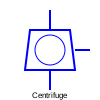
Centrifuge (FF-101)
Type: Basket Type
Capacity: 2.1 m³/batch
Separation: 95% water & phenol removal
Material: Stainless Steel
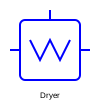
Dryer (DE-101)
Type: Vacuum Tray Dryer
Tray Area: 190 m²
Capacity: 1,898 kg/h
Temperature: 20-70°C
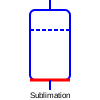
Sublimation Tank (SB-101)
Volume: 20 m³
Pressure: 10 kPa (vacuum)
Temperature: 150-200°C
Type: Jacketed Vacuum Vessel
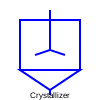
Crystallizer (C-101)
Volume: 20 m³
Type: Desublimer
Temperature: 25°C
Cooling Load: 330 kW
Material Balance Analysis
Overall Material Balance
Feed Streams
Phenol: 1,809 kg/h
NaOH: 699 kg/h
CO₂: 1,148 kg/h
H₂SO₄: 591 kg/h
Total Feed: 4,247 kg/h
Product Streams
Salicylic Acid: 1,665 kg/h
Byproducts: 856 kg/h Na₂SO₄
Waste Water: 4,642 kg/h
Unreacted CO₂: 600 kg/h
Total Output: 7,763 kg/h
Stream Compositions
| Stream | Phenol | NaOH | Sodium Phenolate | Water | CO₂ | Sodium Salicylate | H₂SO₄ | Salicylic Acid | Na₂SO₄ | Total (kg/h) |
|---|---|---|---|---|---|---|---|---|---|---|
| S1 (Phenol Feed) | 1,809 | - | - | 3,015 | - | - | - | - | - | 4,824 |
| S2 (NaOH Feed) | - | 699 | - | 1,399 | - | - | - | - | - | 2,098 |
| S3 (CSTR Outlet) | 1809 | 84 | 4,847 | 47,28 | - | - | - | - | - | 6,924 |
| S5 (Flash Liquid) | 164 | 84 | 4,847 | 95 | - | - | - | - | - | 2,282 |
| S8 (Autoclave Outlet) | 164 | 84 | 606 | 95 | 614 | 4,678 | - | - | - | 6,241 |
| S12 (Acidification Outlet) | 3,939 | 84 | 1,454 | 44,967 | - | 468 | 591 | 3,960 | 856 | 18,746 |
| S17 (Final Product) | 158 | 84 | - | 54 | - | 468 | - | 3,960 | 856 | 6,127 |
| S19 (Pure SA) | - | - | - | 2 | - | - | - | 1,665 | - | 1,667 |
Unit-wise Material Balance
| Component | Input (kg/h) | Output (kg/h) |
|---|---|---|
| Phenol | 1,809 | 164 |
| NaOH | 699 | 3.5 |
| Sodium Phenolate | - | 2,020 |
| Water | 4,413 | 4,728 |
| Total | 6,921 | 6,916 |
Energy Balance & Utility Requirements
Total Energy Consumption
Unit-wise Energy Duties
Detailed Energy Calculations
CSTR Energy Balance
Q₁ (Feed Cooling): -2.86 × 10⁶ kJ/h
ΔHRXN: 2.64 × 10⁷ kJ/h
Q₂ (Product Heating): 4.48 × 10⁷ kJ/h
Total Q: 6.83 × 10⁷ kJ/h = 18,975 kW
Flash Tank Duty
Q = (2.203 kmol/h × 54,200 kJ/kmol) + (6,177.96 kmol/h × 40,680 kJ/kmol)
Q = 2.51 × 10⁸ kJ/h = 69,844 kW
Economic Analysis
Total Capital Investment
$3,771,926
Fixed Capital: $3,279,936
Working Capital: $491,990
Annual Production Cost
$12,900,000
Variable: $7,045,000
Fixed: $3,704,990
Revenue & Profit
$16,500,000
Gross Profit: $3,600,000
Net Profit: $2,340,000
Key Metrics
62% ROI
Payback: 1.6 years
Prod. Cost: $0.98/kg
Equipment Cost Breakdown
| Equipment | Cost (USD) | % of Total |
|---|---|---|
| Dryer | 189,650 | 26.3% |
| Centrifuge | 118,720 | 16.5% |
| Autoclave | 95,550 | 13.3% |
| Acidification Tank | 74,060 | 10.3% |
| Storage Tanks | 68,940 | 9.6% |
| CSTR | 59,770 | 8.3% |
| Dilution Tank | 30,910 | 4.3% |
| Distillation Column | 36,950 | 5.1% |
| Others | 69,440 | 6.3% |
HAZOP Study & Safety Analysis
HAZOP Guide Words
NO
Negation of design intent
LESS
Quantitative decrease
MORE
Quantitative increase
PART OF
Qualitative decrease
AS WELL AS
Qualitative increase
REVERSE
Logical opposite
OTHER THAN
Complete substitution
Safety Considerations
Process Safety
- Autoclave designed for 4.9 bar with 1.4 safety factor
- Phenol storage with nitrogen blanketing and vapor recovery
- Dust explosion protection in dryer and packaging areas
- Emergency relief systems on all pressure vessels
Personal Protection
- Full PPE required in phenol handling areas
- Eye wash stations within 15 seconds reach
- Emergency decontamination showers
- Self-contained breathing apparatus for firefighting
Environmental Controls
- Phenol wastewater treatment to <0.5 ppm discharge
- CO₂ recovery system for unreacted gas
- Sodium sulfate by-product recovery
- Scrubbers for acid vapor containment
HAZOP Team Structure
HAZOP Leader
Plans sessions, controls discussion, motivates team
Process Engineer
Provides process description and design intentions
Chemist
Provides chemical hazards and reaction details
Plant Engineer
Provides site-specific operational experience
References
- McCabe, W.L, Smith, J.C, Harriot, P. "Unit Operations of Chemical Engineering", 5th Ed, McGraw Hill New York, 1993.
- Perry, R.H and D.W. Green (eds): "Perry's Chemical Engineering Handbook", 7th edition, McGraw Hill New York, 1997.
- J. M. Smith, H. C. Van Ness, M. M. Abbot, "Introduction to Chemical Engineering Thermodynamics", 5th Edition. McGraw Hill New York, 1996.
- D. M. Himmeblau, "Basic Principles and Calculations in Chemical Engineering", 6th Edition, Pearson Education Schweiz AG, 1996.
- Krik-Othmar, Encyclopedia of Chemical Technology, Third Edition. Volume 1. John wiley and Sons, New York, NY, 1980.
- Stanely M. Walas, "Chemical Process Equipment Selection and Design", Butteworth-Heinemann USA, 1988.
- Carl R. Branan, "Rules of thumb for Chemical Engineers", Gulf Publishing Company, Houston, TX, 3rd Editions, 2002.
- Harry Silla, "Chemical process Engineering Design and Economics", Marcel Dekker Hoboken, New Jersey USA, 2003.
- Dennis R. Moss. "Pressure Vessel Design Manual", Elsevier Burlington, USA, 3rd Edition, 2004.
- Edward L. Paul, Victor A. Atiemo-Obeng, Suzanne M. Kresta. "Hand Book of Industrial Mixing Science and Pratice", John Willy & Sons, Hoboken, New Jersey, 2004.
- Max S. Peters, Klaus D. Timmerhaus, Ronald E. West, "Plant Design and Economics for Chemical Engineers", McGraw Hill New York, 5th Ed., 2001.
- J.M. Coulson, J.F. Richardson, R. K. Sinnott, "Coulson & Richardson's Chemical Engineering, Chemical Engineering Design", Butterworth Heinemann, USA, 3rd Ed. Vol.6, 2003.
- Ludwig, E.E, "Applied Process Design", 3rd ed, vol. 2, Gulf Professional Publishers, 2002.
- Ludwig, E.E, "Applied Process Design", 3rd ed, vol. 3, Gulf Professional Publishers, 2002.
Project Credits
Project Development
Authors:
- Mohammed Ahmed Dighriri (202003311)
- Marzoug Mohammed Musa Hazzazi (202003782)
Supervisor: Dr. Saleh Matar
Institution: Jazan University
College of Engineering and Computer Science
Chemical Engineering Department
Project Objective
This senior design project was submitted in partial fulfillment of the requirements for the Bachelor of Science degree in Chemical Engineering (May 2025).
The project demonstrates comprehensive application of chemical engineering principles including:
- Process design and simulation
- Equipment sizing and mechanical design
- Material and energy balance calculations
- Economic analysis and feasibility studies
- Safety and hazard analysis (HAZOP)
- Instrumentation and control systems
Acknowledgments
The authors express gratitude to:
- Dr. Saleh Matar for supervision and guidance
- Jazan University for facilities and support
- Chemical Engineering Department faculty
- Family and friends for continuous support